Week 1 of Training

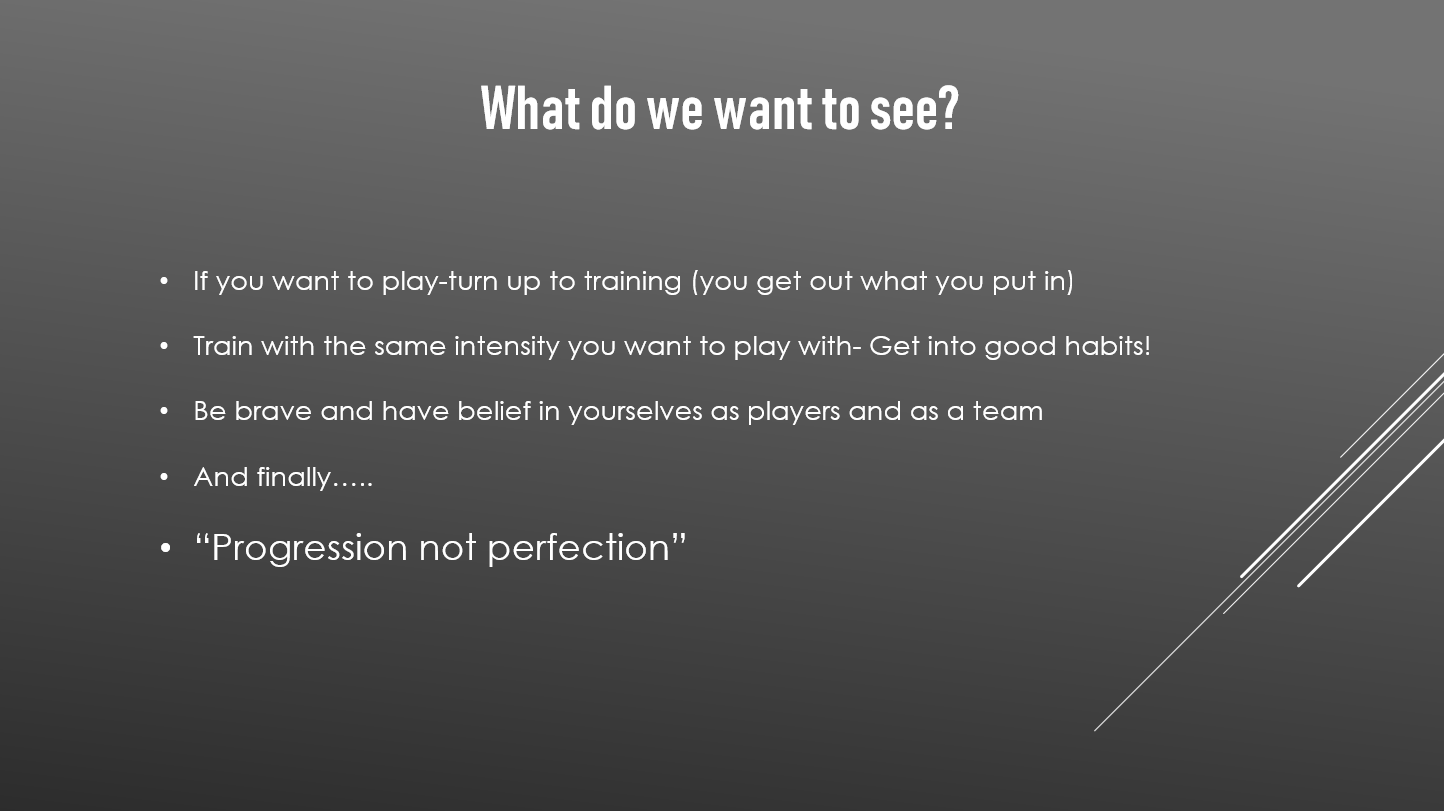
Once the squad was picked and the successful players were invited to training, we asked them to meet us in a classroom where we spent around 20 minutes presenting the playing philosophy we were looking to implement for the season, and certain standards we were looking for as a minimum.

We felt last season that training performances were poor from the players, but we believed that was partly down to us both being new and not organising our sessions as well as we would have liked. We knew in the summer that we would plan all sessions properly over the weekend prior to training and that each session would have specific targets and goals that we wanted to hit in terms of developing this playing philosophy. Therefore because we were doing this, we asked for the players to improve their performances in training and to train with the same intensity that they would play a game with. The points were basic, but we wanted to see improvement from last season, which was outlined by the very cliche “Progression no Perfection” bullet point that was used.
Playing Style

The second part of the presentation was to describe and explain the style of play that we would be looking to play this season. A fair few of the lads from last season were still in the squad, and they were used to the 3-5-2 from the previous year. We explained to them and the new players that we would be opting for a 4-3-3 this year, with our secondary formation being a 4-4-2. The thinking behind this was that we noticed a lot of goals at this level tend to come from wide play, and with a 3-5-2, you will generally end up with the Wing Backs being overloaded by the opposition winger and full back, so we felt that allowing more defensive support out wide would be of benefit, as would having more attacking threat on the wings.

We also set out to make a conscious effort to try and play from the back and make everyone feel confident in possession. I spent some time over the summer studying several elite coaches by reading analysis blogs, coaching books and watching football, and I liked the idea that Marcelo Bielsa has used historically which is that of a 3-3-3-1 on goal kicks (Shown below). This was presented to the players, and the idea is that the 2 Centre Backs split towards the corners of the area, the holding midfielder drops in around the D of the area, with the Full Backs pushing up and hugging the touchline. The 2 Central midfielders divide themselves so one pushes forward in support of the Centre Forward, with the other one dropping back and being the link player. The wingers then come into the pitch to become narrower and to try and cause confusion for the defenders.
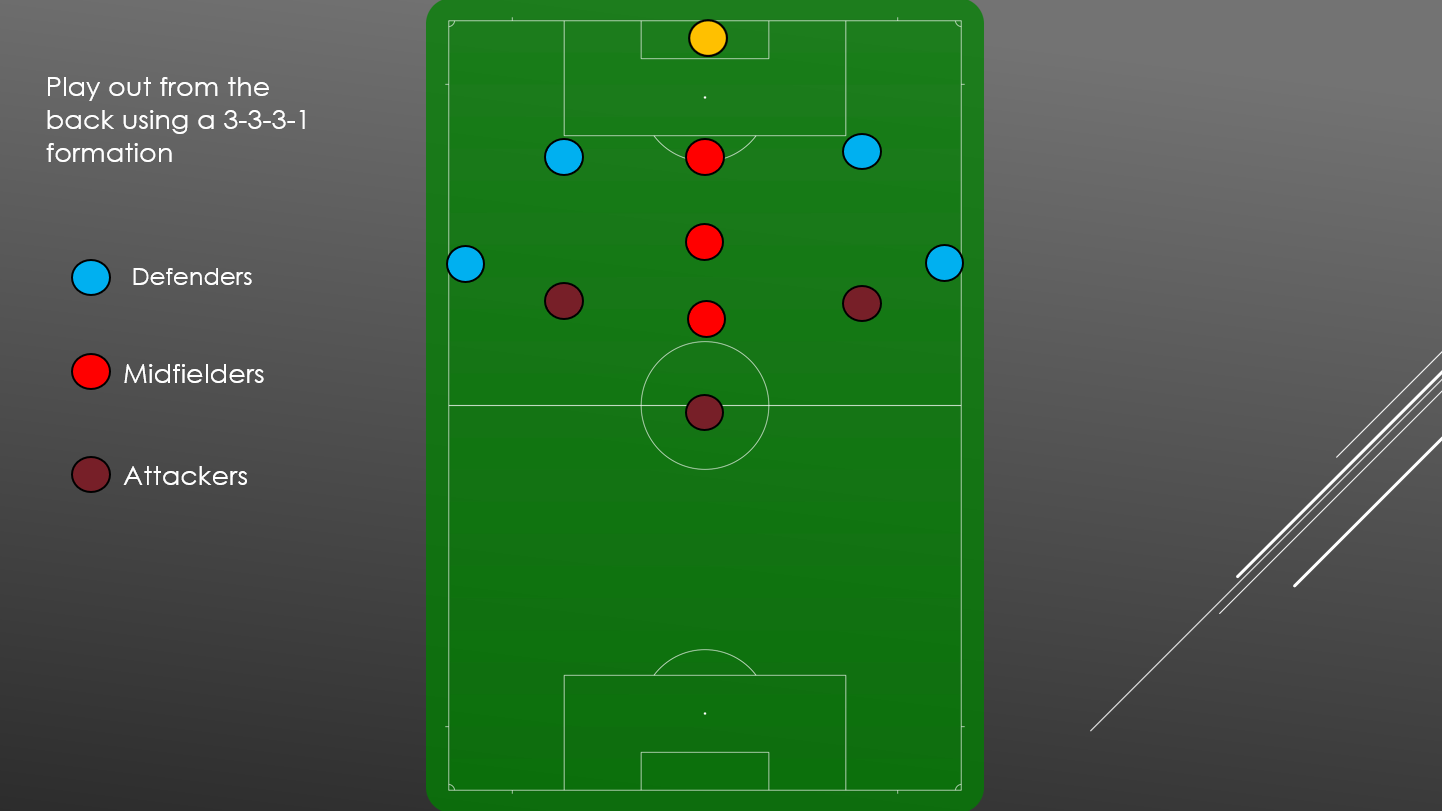
We felt that this would be fairly easy to implement as we knew from last season that our defenders were confident in possession, and our goalkeeper was also composed with the ball at his feet. The main concern was that if we get caught out once trying to play this way, that the lads would panic and resort to long ball instead. This playing out from the back formed the main part of the session as well as trying to coach defending from the front.

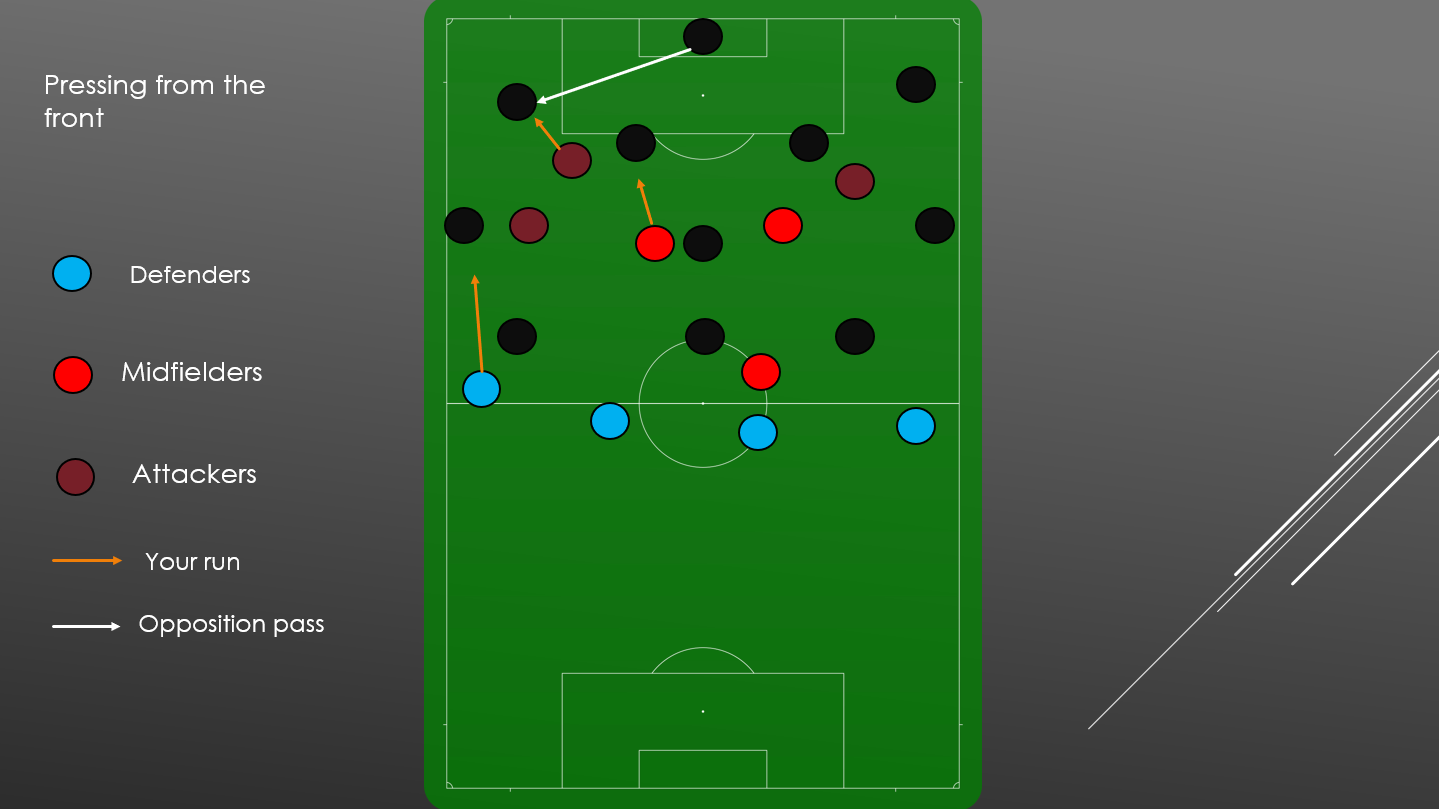
Knowing that the speed of the team is above average for this age and this level, we wanted to try and implement a high pressing style as much as we possibly could. This in my opinion is something that can’t be taught in one 1h30 session once a week and would be something that we would see a gradual improvement on over the games that we play. In the session, as the defenders were looking to play out from the back, the defenders were asked to press high and win the ball back. It was fair to say that the defenders won this little contest as they showed fantastic levels of composure at times and played through the press with relative ease.
As this was the first session the lads had together, the session was ended by just covering a few basics in preparation for the first game of the season that was approaching. So the final 10-15 minutes of the session was spent on Attacking & Defending corners. This was a weakness for us last season, (and haunted me as we played a game towards the end of the season where the opponent didn’t actually get into our half for the first 10 minutes of the game, however we conceded a corner cheaply and as a result went 1-0 down from some terrible defending) so we needed to ensure we were well prepared for this going into the first game which would be away in a couple of days time in Wrexham.
Second Trial Week

Scott ensured that we had 2 trial weeks to full evaluate the trialists, and to ensure any players who could not make the first week were able to attend the second trial. A few of the lads who turned up in the first week failed to turn up in the second week which was a bit disappointing, however there was a few new trialists which was good to see.


New Trialists

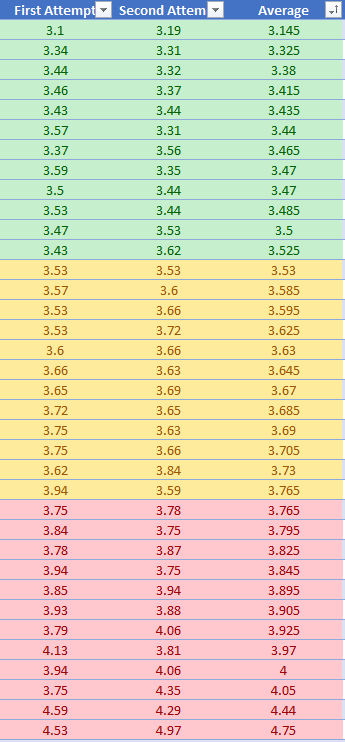
The new trialists went through the same physical testing as the Week 1 trialists. This was handled by myself, and Scott took the Week 1 trialists away to do a separate warm up and some general ball work. From the new trialists, a couple managed the half pitch test which was a good sign. However most did struggle, and although this isn’t a good thing for them, it is good for me and Scott as we really are able to separate the fittest players from the not so fit players. Again the 20 yard sprint test was done, and their results were added to the data for further evaluation. (Data attached below as per previous post)

One thing that maybe hasn’t been addressed yet in terms of physicality is height. Depending on the style of play, and the philosophy of the coach, a lot of importance is often place upon height of the players. For me and Scott, we paid no attention to this at all. Players were picked based on speed, stamina and technical ability, height was in no way a factor when choosing players.

The Trial Game

After the first trial session, me and Scott had a fairly strong idea of which players we felt would make the squad from that trial, so we set up a game that had as close to the 11 players we wanted as possible against the rest of the trialists. Just like in the first game, substitutions were made around every 10-15 minutes to try and allow players the opportunity to showcase their ability. The thinking behind dividing the teams in this manner was that we felt that stronger XI was a very good team, and that any player that stood out against them would likely be good enough to also make the squad. This soon became evident, and one of the new Week 2 trialists on the ‘Weaker Team’quite obviously showed a higher level of ability than his team mates. We swapped him across to the stronger XI to see how he worked in that team, and to see if he was just as effective as he was in the weaker team.

Picking the Squad

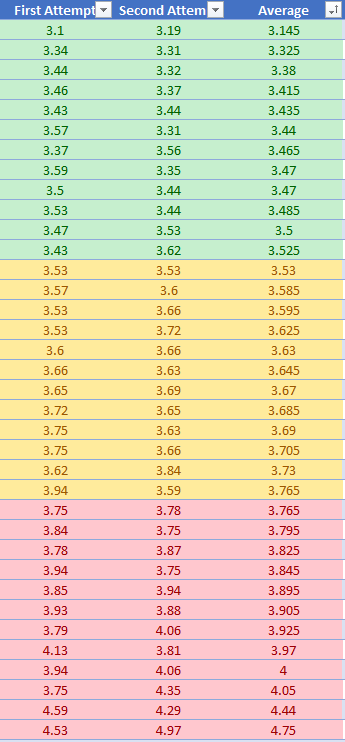
After the trials had taken place, and we had the results of the physical testing as well as our notes around the technical and mental abilities of the players, we had to select a squad of around 18-19. This turned out to be more difficult than we expected with certain trialists leaving the college, as well as some not turning up for the Week 2 trials. There were also some players who maybe didn’t show their full potential in the trials but this will be addressed later on. What did become evident though was that the 15 fastest players on average from the 20-Yard Sprint test (shown above) did make the squad. Although we did want players who were athletic and quick, these players didn’t make the squad just because of their pace, they also impressed in the other areas.

Improvements

One of the lads didn’t impress to much in the physical tests or even in the trial game, and he didn’t make the initial squad. Luckily as Scott teaches a lot of the trialists and sees them play every day in college, he noticed his ability. Although we were extremely happy with the squad we chose, it does go to show that there may always be one or two who slip through the net. Looking back on this now, this particular lad was being asked to play Central Midfield in a 4-4-2 formation, and his weakness is his pace in comparison to the rest of the team. I feel this was what made him struggle to make an impact, as when he is played as the defensive pivot in a midfield 3, with runners either side of him, he is a completely different player, and has become a regular starter for us.

I feel that next season when/if we were to do the trials again, we may have to mix up the systems more, because although there’s a certain way we want to play, there may be a more suitable system that suits the players we have, and they would be able to showcase this in the trials.

18/19 Season

Along with my friend and former colleague Scott, we decided to continue our leadership of the Wirral Met College Football team for the 18/19 season. As we took over around the January of the previous season, the squad and style of play was already set out then so we were unable to make any radical changes, however this season we wanted to try and put our stamp on the team.

Playing Style

From the previous season we knew we were going to lose a few of the better technical players who had left the college, however we still chose to create a style that would focus as much as possible on shorter passin, being technical and teaching the lads to be patient in possession. Being in the region of the country we are, we looked at the defensive style of Liverpool in terms of the general energy levels and high press, and felt that a lot of the lads would be receptive to learning this style as so many of them support Liverpool, so we aimed to implement this as our defensive style. We also decided to move from the 3-5-2 that was used in the previous season and look to play a 4-3-3 and try and be more offensive as chance creation was the issue in the previous season. From this blueprint, we knew that when we held the trials we would need to look for players with high energy levels, who are able to cover distances of 10-20 yards in a very quick pace. On top of this, we wanted players who were technically sound and able to keep possession. We also felt that from the previous season there was something of a divide in the changing rooms which didn’t help performances, so we wanted to keep a keen eye on the psychological traits of the trialists and how they were able to work together as a team. Another idea we decided upon was to get the players to take the warmups once the team was selected. There were 2 reasons for this, 1. It is a good icebreaker and helps players come out of their shell with their team mates, and 2. Players at all levels now prefer empowerment, and responsibility and this would allow them to have that, rather than me and Scott dictating the entire session to them.

Trials-Trial 1

First thing was to advertise the trials to the college. Scott did this by posting the time and date on the college intranet so all students from all campuses were able to see and attend should they choose to. We had around 26-28 lads turn up for the 2 dates which was great for us to see the enthusiasm around the college for football.

Physical Testing

In the first week, all the lads who attended undertook some physical tests. Scott had seen Jurgen Klopp doing a version of a bleep test which involved the Liverpool players doing continuous laps of the pitch with a time limit set, which resulted in a last man standing type scenario to see who was the fittest in the team. We thought something along the same lines would be good to see who was fit enough to make it onto the shortlist, and also from a psychological point of view, you get to see which lads give up when they’re tired, and which lads will power on through regardless of how tired they are. As our lads are amateurs aged between 16-20 years of age, we changed the drill slightly to make it more relevant for that level. The test was done around half a pitch, and was done in several stages. As we had never done this test before, we were unsure of what time limit to set to begin with. We started with 2 minutes, with a 20 second rest before the next round. This turned out to be far too long with everyone completing this easily. The second time around we brought the time down to 1 minute 20 seconds, again with a 20 second gap before the next round. A few here started to drop out which was a good sign, as this was still a generous amount of time to complete this in, even after having 2 minutes to get around the first time. The third time moved down to 1 minute with the same rest time, then 50 seconds, 40 seconds and eventually ending at 35 seconds. All the lads that got as far as the 50 second limit and below had their name put on a provisional list as players to watch out for.

The second stage of the physical testing was around speed. Scott had found some SPARQ testing sheets for football, so we took the 20-yard sprint test from that, and measured each candidate over that distance, with them performing this test twice. The trialists weren’t sifted from this immediately, as there was a lot of data, so the information was input into a spreadsheet on Excel, and then each trialists average speed was found out. From this they were then divided into 3 groups, Quick, Average, Below Average as shown below. (Includes week 2 trialists)


Technical, Tactical & Social Testing

The 2nd part of the trials was around general footballing ability, and seeing who was capable of playing 11-aside football at this level. The players were asked to divide themselves up into Goalkeepers, Defenders, Midfielders and Forwards. From this me and Scott then chose 2 teams. As we knew a few of the trialists from the previous season, we tried to divide these lads up as much as possible and also put them in an unfamiliar team. The 2 teams were divided up, with the Red Bibs playing a 4-3-3 (preferred starting formation) and the Blue Bibs playing a 4-4-2 (secondary formation for the season). As there was around 13-14 players for each side, we tried to make substitutions every 10-15 minutes to allow everyone a chance to impress, and also in other positions. Occasionally we would swap a Blue for a Red, as we thought there may be certain attributes we could see in them that would compliment each other so we wanted to see certain player combinations playing together. Whilst the game was going on we made notes on a few of the players that we felt would be good enough to make the team.

Changes

As this was the first time we had done something like this we felt this went well. We knew there was another trail day coming up the following Monday so we were looking forward to seeing the players again. One thing I feel I would change from this would be to have numbered bibs as it can be difficult to learn 20-25 new names in such a short space of time.